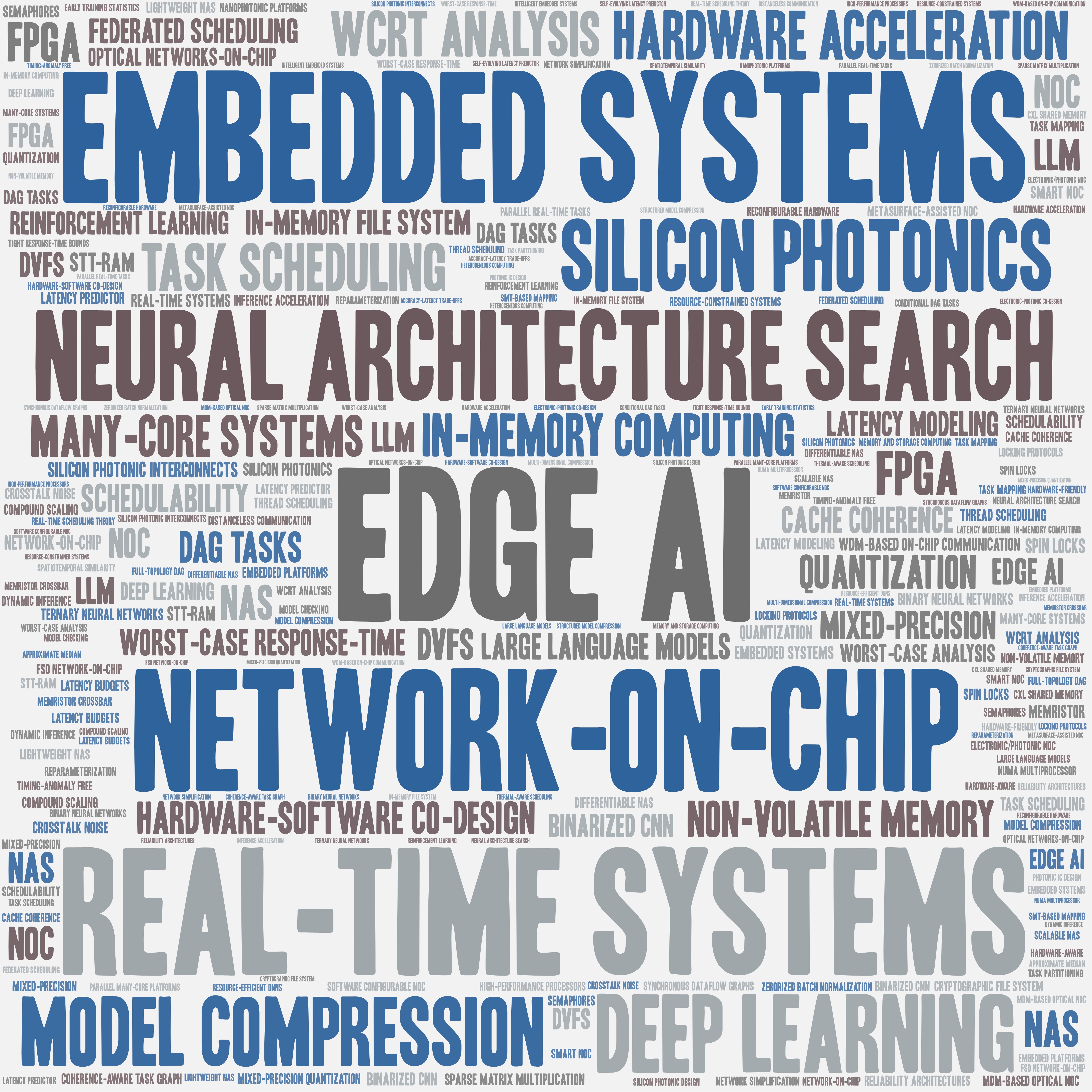
Weichen Liu's research interests lie at the intersection of AI and edge computing, addressing the challenge of building computing systems that are simultaneously intelligent, efficient, and temporally predictable. He develops hardware-aware neural architecture search, structured model compression, and in-memory acceleration techniques to deploy deep learning within tight latency and energy budgets on constrained devices. In parallel, his research spans a broad range of system-level challenges, including real-time scheduling theory, photonic integrated circuit (IC) design, and hardware/software co-design for parallel embedded platforms. His research is supported by Intel, AMD, Xilinx, MediaTek, Huawei, and HP Inc. (more →)
| Year | Award | Venue | Location |
|---|---|---|---|
| 2024 | Special Mention | Singapore Open Research Awards | Singapore |
| 2024 | Best Paper Candidate | DAC | San Francisco, CA, USA |
| 2023 | HiPEAC Paper Award | HiPEAC | Toulouse, France |
| 2023 | Best Paper Candidate | DATE | Antwerp, Belgium |
| 2022 | Best Research Award | STCAI | Singapore |
| 2022 | Best Paper Candidate | GLSVLSI | Irvine, CA, USA |
| 2022 | Publicity Paper | DAC | San Francisco, CA, USA |
| 2020 | 3rd Place | IEEE EDAthon | Hong Kong |
| 2020 | Best Poster Award | ACM SIGDA Forum @ ASP-DAC | Beijing, China |
| 2020 | Best Paper Candidate | ASP-DAC | Beijing, China |
| 2019 | Best Paper Candidate | ASP-DAC | Tokyo, Japan |
| 2018 | Nanyang Assistant Professorship | NTU | Singapore |
| 2017 | A. Richard Newton Young Student Advisor Award | DAC | Austin, TX, USA |
| 2017 | Best Poster Paper | RTCSA | Hsinchu, Taiwan |
| 2017 | Best Poster | ACM SIGDA Forum @ ASP-DAC | Chiba, Japan |
| 2016 | Best Paper Candidate | ASP-DAC | Macau, China |
| 2015 | Best Paper Candidate | CASES (ESWEEK) | Amsterdam, Netherlands |
| 2010 | Best Poster Award | AMD Technical Forum & Exhibition | Taiwan |
| 2009 | Best Paper Candidate | CODES+ISSS (ESWEEK) | Grenoble, France |
| 2005 | MediaTek Inc. & Wu Ta-You Scholar Award | MediaTek Inc. | Taiwan |
We are actively seeking motivated PhD students and Postdoc Research Fellows with a strong interest in edge AI, hardware acceleration, and silicon photonics. Interested applicants are encouraged to submit their inquiries via email. Please note that only shortlisted candidates will be notified.
Note: the research group is currently unable to host overseas interns or visiting undergraduate students who require financial assistance. However, exchange PhD students with institutional support are welcome to enquire.
| Name | Degree | Year | Current Position |
|---|---|---|---|
| Dr. Xiangzhong LuoPubs | PhD | 2023 | Tenure-Track Associate Professor, Southeast University |
| Dr. Hao KongPubs | PhD | 2023 | Scientist, Huawei Technologies, Shanghai |
| Dr. Shiqing LiPubs | PhD | 2023 | Researcher, Illinois Advanced Research Center at Singapore (UIUC) |
| Dr. Shuo HuaiPubs | PhD | 2023 | Postdoctoral Researcher, NTU |
| Dr. Shien ZhuPubs | PhD | 2022 | Postdoctoral Researcher, ETH Zurich |
| Dr. Hui ChenPubs | PhD | 2022 | Huawei Top Minds (天才少年) Program, Dongguan |
| Dr. Peng ChenPubs | PhD | 2021 | Associate Professor, Chongqing University of Posts and Telecommunications (CQUPT) |
| Dr. Mengquan LiPubs | PhD | 2020 | Associate Professor, Hunan University |
| Dr. Lei YangPubs | PhD | 2019 | Assistant Professor, George Mason University |
| Name | Role | Period | Current Position |
|---|---|---|---|
| Dr. Balasubramanian PadmanabhanPubs | Senior Research Fellow | Aug 2022–Apr 2023 | R&D Consultant (independent) |
| Dr. Vijaya Bhaskar AdusumilliPubs | Research Fellow | Jan 2023–Oct 2023 | Assistant Professor, SRM University-AP |
| Dr. Di LiuPubs | Research Fellow | Jan 2020–Jan 2022 | Tenured Associate Professor, Norwegian University of Science and Technology (NTNU) |
| Dr. Jun ZhouPubs | Research Fellow | Apr 2019–Feb 2021 | Research Engineer, MITECH Corporation, Japan |
| Dr. Luan H. K. DuongPubs | Research Fellow | Aug 2018–Apr 2021 | Senior Lecturer, The Ohio State University |
| Mr. Vikash SathiamoorthyPubs | Research Associate | Feb 2022–Oct 2023 | Research Data Scientist, NTU Singapore |
| Ms. Lei ZhangPubs | Research Associate | Oct 2019–Jan 2021 | Algorithm Engineer, Geega Technology |
| Ms. Wendy Yong Yi LoyPubs | Project Officer | Nov 2021–May 2023 | Statistician, Singapore Department of Statistics |
| Mr. Wenyang LiuPubs | Project Officer | Apr 2019–Jan 2021 | PhD Student & Research Associate, NTU Singapore |
| Name | Role | Period | Home Institution |
|---|---|---|---|
| Mr. Zhaolong JianPubs | Visiting PhD Student | Mar 2025–Mar 2026 | Nankai University |
| Ms. Yili GuoPubs | Visiting PhD Student | Jan–Dec 2025 | Hunan University |
| Ms. Liping YangPubs | Visiting PhD Student | Jan–Dec 2025 | Hunan University |
| Ms. Fenfang LiPubs | Visiting PhD Student | Sep 2024–Sep 2025 | Hunan University |
| Ms. Xiangzhen XiaoPubs | Visiting PhD Student | Jan–Dec 2024 | Hunan University |
| Mr. Yinjie FangPubs | Visiting PhD Student | Jan–Dec 2024 | Hunan University |
| Ms. Bingting JiangPubs | Visiting PhD Student | Nov 2022–Nov 2023 | Hunan University |
| Mr. Haotian WangPubs | Visiting PhD Student | Sep 2022–Sep 2023 | Hunan University |
| Ms. Peiying LinPubs | Visiting PhD Student | Feb 2022–Feb 2023 | Hunan University |
| Mr. Xinyang DongPubs | Visiting PhD Student | Mar 2022–Jun 2023 | Northeastern University |
| Ms. Shuangshuang ChangPubs | Visiting PhD Student | Aug 2021–Aug 2022 | Northeastern University |
| Mr. Pengxing GuoPubs | Visiting PhD Student | Oct 2018–Jun 2020 | Northeastern University → Assistant Professor, CQUPT |
| Mr. Yuhao JiPubs | Visiting Undergraduate | Oct–Dec 2023 | Nanjing University → PhD Student, CUHK |
| Mr. Chunyun ChenPubs | Visiting Undergraduate | Nov 2019–May 2020 | UESTC → PhD Student, NTU |
| Mr. Chunhui WuPubs | Visiting Undergraduate | Jul–Aug 2019 | USTC → PhD Student, USTC |
| Mr. Fuyuan LyuPubs | Visiting Undergraduate | Sep 2018–Feb 2019 | SJTU → PhD Student, McGill University |
| Mr. Kaivalya SwamiPubs | Visiting Undergraduate | May–Jul 2019 | IIT Delhi → DevRev |
| Code | Course Title | Level | Terms |
|---|---|---|---|
| SC1006 | Computer Organization and Architecture | Undergraduate | 2025–present |
| SC3050 | Advanced Computer Architecture | Undergraduate | 2022–present |
| SC2079 / CE3004 / CZ3004 | Multi-Disciplinary Project | Undergraduate | 2023–2025 |
| SC2107 / CE2107 | Microprocessor System Design and Development | Undergraduate | 2022–2023 |
| CZ3001 / CE3001 | Advanced Computer Architecture | Undergraduate | 2017–2026 |
| CZ3002 | Advanced Software Engineering | Undergraduate | 2019–2020, 2022–2023 |
| CZ2006 / CE2006 | Software Engineering | Undergraduate | 2018–2020 |
| CZ1006 / CE1006 | Computer Organisation and Architecture | Undergraduate | 2018–2020 |
| CZ2005 / CE2005 | Operating Systems | Undergraduate | 2017–2018, 2021–2022 |
Office hours: by email appointment.
| Period | Role | Journal |
|---|---|---|
| 2026–present | Subject Area Editor | IEEE Transactions on Computer-Aided Design (IEEE TCAD) |
| 2022–2025 | Associate Editor | IEEE Transactions on Computer-Aided Design (IEEE TCAD) |
| 2018–present | Subject Area Editor | Journal of Systems Architecture (JSA), Elsevier |
| 2024–2025 | Associate Editor | IEEE Embedded Systems Letters (IEEE ESL) |
| 2022–2023 | Guest Editor | ACM Transactions on Embedded Computing Systems (ACM TECS) — Special Issue on In/Near-Memory and Storage Computing |
| 2021–2022 | Guest Editor | Journal of Systems Architecture (JSA) — Special Issue on Memory and Storage Computing |
| 2020–2021 | Guest Editor | Microprocessors and Microsystems (MICPRO) — Special Issue on Memory and Storage Computing |
| 2015–2016 | Associate Editor | Journal of Circuits, Systems and Computers (JCSC), World Scientific Press |
| Period | Role | Conference / Event |
|---|---|---|
| 2026 | Program Chair | 44th IEEE International Conference on Computer Design (ICCD) |
| 2025 | Publication Co-Chair | ACM/IEEE Embedded Systems Week (ESWEEK) |
| 2024 | Track Chair (Architecture) | International Conference on Networking, Architecture and Storage (NAS) |
| 2023 | Track Chair (OS Platforms) | IEEE International Symposium on Embedded Multicore/Many-core Systems (MCSoC) |
| 2021–2022 | Program Chair | IEEE International Conference on Intelligent Transportation, Infrastructure and Computing (ICITES) |
| 2021–2022 | Track Chair (Software and Applications) | ACM/IEEE International Symposium on Low Power Electronics and Design (ISLPED) |
| 2020–2022 | General Chair | International Workshop on Memory and Storage Computing (MSC) @ ESWEEK |
| 2020–2022 | Organizing Committee | Workshop on Edge AI @ IEEE ICDCS |
| 2020 | General Chair | 25th IEEE International Symposium on Real-Time Computing (ISORC) |
| 2019–2021 | General Chair | Student Research Forum (SRF) @ ASP-DAC |
| 2019 | Program Chair | 24th IEEE International Symposium on Real-Time Computing (ISORC) |
| 2019 | Special Session Chair | IEEE Computer Society Annual Symposium on VLSI (ISVLSI) |
| 2014 | Program Chair | International Workshop on Embedded Multi-Core Systems and Applications |
| Years | Conference |
|---|---|
| 2016–2023, 2026 | ACM/IEEE International Conference on Hardware/Software Codesign and System Synthesis (CODES+ISSS) |
| 2020–2022, 2026 | ACM/IEEE Design Automation Conference (DAC) |
| 2014, 2017, 2019, 2026 | IEEE International Conference on Embedded and Real-Time Computing Systems and Applications (RTCSA) |
| 2026 | ACM International Conference on Embedded Software (EMSOFT) |
| 2025 | ACM/IEEE Design, Automation and Test in Europe (DATE) |
| 2016, 2017, 2020–2023 | ACM/IEEE Asia and South Pacific Design Automation Conference (ASP-DAC) |
| 2019–2022 | ACM/IEEE International Symposium on Low Power Electronics and Design (ISLPED) |
| 2019, 2020, 2021 | ACM/IEEE International Conference on Computer-Aided Design (ICCAD) |
| 2021 | ACM Symposium on Applied Computing (SAC) |
| 2018, 2020 | IEEE Real-Time Systems Symposium (RTSS) |
| 2020 | IEEE International Conference on Parallel and Distributed Systems (IEEE ICPADS) |
| 2018, 2019 | IEEE Real-Time and Embedded Technology and Applications Symposium (RTAS) |
| Years | Conference |
|---|---|
| 2015, 2016, 2019 | IEEE International Conference on Embedded Software and Systems (ICESS) |
| 2017, 2018 | ACM Great Lakes Symposium on VLSI (GLSVLSI) |
| 2018 | ACM/IEEE International Symposium on Networks-on-Chip (NOCS) |
| 2017, 2018 | ACM/IEEE Student Research Competition @ ICCAD (SRC@ICCAD) |
| 2017 | IEEE International Conference on Embedded Software Technology and Communication (ESTC) |
| 2015 | IEEE International Conferences on High Performance Computing and Communications (HPCC) |
| 2015 | CAD/Graphics Conference |
| 2014 | International Conference on Networking, Architecture and Storage (NAS) |
| 2014 | IEEE International Symposium on Embedded Systems Education (SES) |
| 2013 | International Symposium on Electronic System Design (ISED) |
| 2012 | IEEE International Conference on VLSI Design |
| Period | Role | Funding Agency |
|---|---|---|
| 2016, 2025–2026 | Expert Committee | General Research Fund (GRF), Research Grants Council of Hong Kong (RGC) |
| 2025 | Expert Committee | Collaborative Research Fund (CRF), Research Grants Council of Hong Kong (RGC) |
| 2015–2017 | Expert Committee | National Natural Science Foundation of China (NSFC) |
| 2017 | Expert Committee | Natural Sciences and Engineering Research Council of Canada (NSERC) |
The lab's research addresses a single recurring challenge: building systems that are simultaneously intelligent, predictable, and efficient, where any one of these properties is easy to achieve in isolation but all three together impose hard tradeoffs. Every problem in the group, whether it involves scheduling theory, on-chip interconnect design, or deep neural network optimization, can be stated as a resource-allocation problem with a correctness side constraint: given a budget of energy, latency, silicon area, or bandwidth, find a solution that satisfies a timing guarantee, a thermal bound, or an inference accuracy target. The lab develops quantitative methods to navigate this tradeoff, including tight worst-case response-time bounds, measured hardware cost models, and automated search over large design spaces. These methods apply to two problem families that share the same underlying structure: embedded systems that must respond correctly within hard real-time deadlines, such as parallel task schedulers and on-chip communication fabrics; and learned models that must run efficiently on constrained edge hardware, such as hardware-aware neural architecture search and structured compression pipelines. The resource-versus-correctness tradeoff appears in both families, and results from one routinely inform the other.
Jointly automating neural architecture search and model compression to produce networks that fit within strict latency, memory, and energy budgets on target embedded hardware. The differentiable NAS line (LightNAS, SurgeNAS, YOSO, Double-Win NAS) reformulates architecture search as a continuous optimization over hardware cost proxies, enabling single-pass search on severely resource-constrained platforms and winning DAC Best Paper recognition in 2024. The compression line (Smart Scissor, EdgeCompress, TAB, CRIMP, Domino-Pro-Max) combines structured spatial pruning, ternary/binary/mixed-precision quantization, and hardware-aligned weight representations to shrink models for crossbar-based in-memory processors and edge SoCs. HACScale further unifies compound scaling with hardware awareness, co-optimizing depth, width, and resolution under a measured latency constraint rather than a proxy FLOPs budget.
Deploying deep neural networks on embedded and edge devices under hard latency deadlines, bridging the gap between DNN accuracy and real-time guarantees. Collate partitions inference workloads across edge-cloud boundaries using a collaborative scheduling framework with formal latency bounds. EvoLP introduces a self-evolving latency predictor that refines its own accuracy through online feedback, enabling latency-aware model compression without repeated hardware measurement. ZeroBN eliminates batch normalization layers through zerorization, pruning architectures under per-layer latency constraints derived from target device profiling. A 2024 survey of efficient deep learning infrastructure for embedded computing systems synthesizes deployment methodologies across GPU, FPGA, NPU, and microcontroller targets.
Rigorous, reproducible evaluation methodology for comparing deep learning deployments across heterogeneous edge hardware. EDLAB is a comprehensive benchmark toolkit covering GPUs, FPGAs, NPUs, and ARM-based SoCs, measuring throughput, energy efficiency, latency, and accuracy under unified workload conditions. The toolkit addresses a fundamental gap: prior edge AI evaluations were conducted on single platforms using inconsistent protocols, making cross-platform comparisons unreliable. EDLAB pairs hardware profiling with a systematic survey of efficient deep learning infrastructures, establishing empirical baselines for future architecture and compression research.
Silicon photonic interconnects using wavelength-division multiplexing and micro-ring resonators offer orders-of-magnitude bandwidth density over electrical wires, but micro-ring resonators shift resonance frequency with temperature, making thermal reliability a first-class routing objective. Routing algorithms minimize WDM contention while providing provable thermal reliability guarantees for resonator operating points (ASP-DAC Best Paper Candidate 2019, IEEE TCAD 2021). Hardware-software collaborated thermal sensing embeds micro-ring resonators as thermometers within the NoC fabric, enabling closed-loop monitoring without dedicated sensor overhead (TECS, DATE 2019). An automated optical accelerator search framework (TCAD 2023) applies NAS-style search to photonic hardware, discovering accelerator configurations with superior energy and bandwidth efficiency. MSONoC (2024) extends the design space to metasurface-assisted hybrid waveguide and free-space optical interconnects, and a 3D mesh optical NoC architecture (TCAD 2013) provides foundational topology analysis across multi-die stacks.
High-performance on-chip interconnect design and power-safe task placement for large-scale multi-core chips, treated as a unified hardware-software co-design problem. The ArSMART line extends SMART NoC to support arbitrary-turn single-cycle multi-hop traversal, proving that contention minimization dominates over hop-count reduction (DAC 2017) and yielding tight worst-case communication latency bounds (TCAD 2021). MARCO provides a task mapping and routing co-optimization framework for point-to-point NoC-based heterogeneous MPSoCs (TECS, CASES 2021), while LAMP introduces load-balanced multipath parallel transmission to raise throughput under heterogeneous traffic. MUGNoC (2023) designs a software-configured multicast-unicast-gather fabric that accelerates CNN dataflow patterns directly in the interconnect. On the dark-silicon side, FoToNoC (ASP-DAC Best Paper Candidate 2016) introduces a folded-torus topology for managing thermally constrained many-core chips, and hardware-software co-optimization frameworks enable selective core activation with DVFS to respect per-chip temperature budgets. A 2025 ML-based approach learns cache coherence traffic patterns to guide adaptive routing decisions.
Formal schedulability analysis and priority assignment algorithms for parallel real-time tasks modeled as directed acyclic graphs (DAGs), executing under federated and partitioned multi-core scheduling. Key results include a minimum WCRT bound for DAG tasks under prioritized list scheduling (EMSOFT 2022, TCAD), timing-anomaly-free dynamic scheduling for conditional DAGs (TECS, EMSOFT 2019), and locking protocols for parallel tasks sharing semaphore resources under federated scheduling (TCAD 2021). Spin-lock analysis for parallel real-time tasks establishes safe and tight bounds on blocking time under hard real-time constraints (IEEE TC 2021). The FT-DAG generator (2025) provides a full-topology benchmark tool for evaluating DAG scheduling algorithms. SAT-based application mapping on multiprocessor systems (CASES Best Paper Candidate) and schedulability analysis on reconfigurable FPGA hardware complete the formal-methods thread.
| Project | Agency | Period | Role |
|---|---|---|---|
| AI-Oriented Software Configurable Network-on-Chip | MOE AcRF Tier 2 | 2025–2028 | Principal Investigator |
| Cache Coherence Induced Network-on-Chip Traffic Characterization | MOE AcRF Tier 1 | 2024–2026 | Principal Investigator |
| Distanceless Communication Architecture for Many-Core Processors | MOE AcRF Tier 2 | 2019–2023 | Principal Investigator |
| Nanophotonic Platforms for Future Computing Systems | MOE AcRF Tier 1 | 2019–2022 | Principal Investigator |
| Edge Processor Evaluation | NRF IAF-ICP / HP Inc. | 2018–2023 | Principal Investigator |
| Emerging Many-Core Processors | Nanyang Assistant Professorship | 2018–2024 | Principal Investigator |
| Emerging On-Chip Communication Architectures | NTU Start-up Grant | 2017–2022 | Principal Investigator |