AI for science and education

We build AI that works hand in hand with physical models, and we study how AI can help students learn to think, not just to answer.

AI for science

Physics gives us models with clear meaning; machine learning finds patterns in large and messy data. We combine the two, using topology and geometry to describe molecules and tissues in ways that a learning algorithm can use.

Predicting how DNA folds

G-quadruplexes are four-stranded DNA structures involved in DNA repair, replication and transcription, and are targets for drug design. Our machine learning models predict their folding topology (G4ShapePredictor) and their thermodynamic stability from sequence and salt conditions (G4STAB).

Topology-enhanced models of biopolymers

We develop simplicial and topological representations of nucleic acids such as double-stranded DNA and G-quadruplexes for featurisation and learning, supported by a Ministry of Education Academic Research Fund Tier 2 grant.

Physics-informed AI for biological dynamics

With Kang Hao Cheong, we are building topology- and geometry-aware, physics-informed AI to understand biological dynamics across scales, including topology-aware graph neural networks.

AI agents for science

Can large language model agents carry out scientific analysis reliably and reproducibly? We are evaluating them, and using AI to help build agent-based models of collective behaviour, such as ant colonies foraging for food.

Selected papers

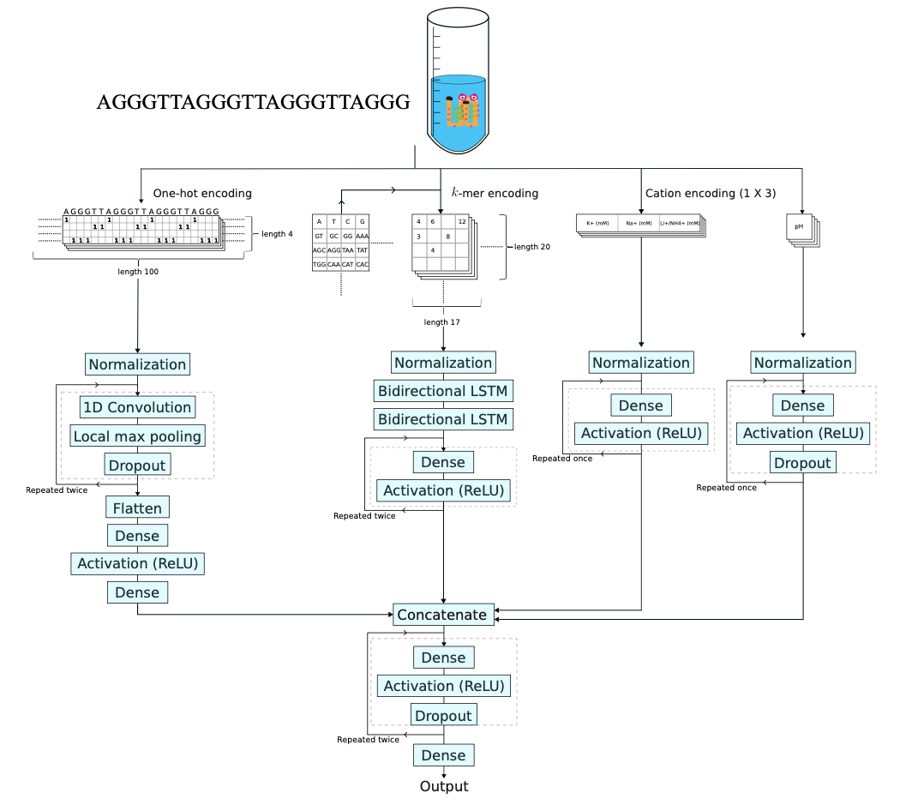
Figure from “G4STAB: a multi-input deep learning model to predict G-quadruplex thermodynamic stability based on sequence and salt concentration”

G4STAB: a multi-input deep learning model to predict G-quadruplex thermodynamic stability based on sequence and salt concentration

Donn Liew, Akesha Dinuli Dharmatilleke, Edwin See, and Ee Hou Yong

Bioinformatics 41(10), btaf545 (2025)

Abstract

G-quadruplexes (G4s) are non-canonical nucleic acid structures formed in guanine-rich regions that modulate gene regulation and genomic stability. The thermodynamic stability of G4s directly influences their biological functions and potential as therapeutic targets. However, current quantitative frameworks for predicting G4 stability rely on predetermined structural features, limiting their effectiveness for diverse G4 topologies, and fail to account for environmental factors such as ion concentration and pH that significantly modulate G4 stability in cellular contexts. We present G4STAB, a multi-input deep learning neural network that accurately predicts DNA G4 melting temperatures based on sequence features, salt concentration, and pH. Trained on 2382 diverse DNA G4 sequences, our model achieves high accuracy (R² = 0.8) without relying on predetermined G4 structural features. G4STAB successfully captures established G4 stability determinants and proposes previously unobserved sequence–stability relationships. Analysis of 391 502 experimentally validated G4s reveals that cancer-like ionic environments alter G4 stability profiles, with a 13.5-fold increase in the number of structures exhibiting physiological melting temperatures (36–42 °C). These findings suggest systematic genomic patterns in G4 stability responses across chromosomes and gene types.
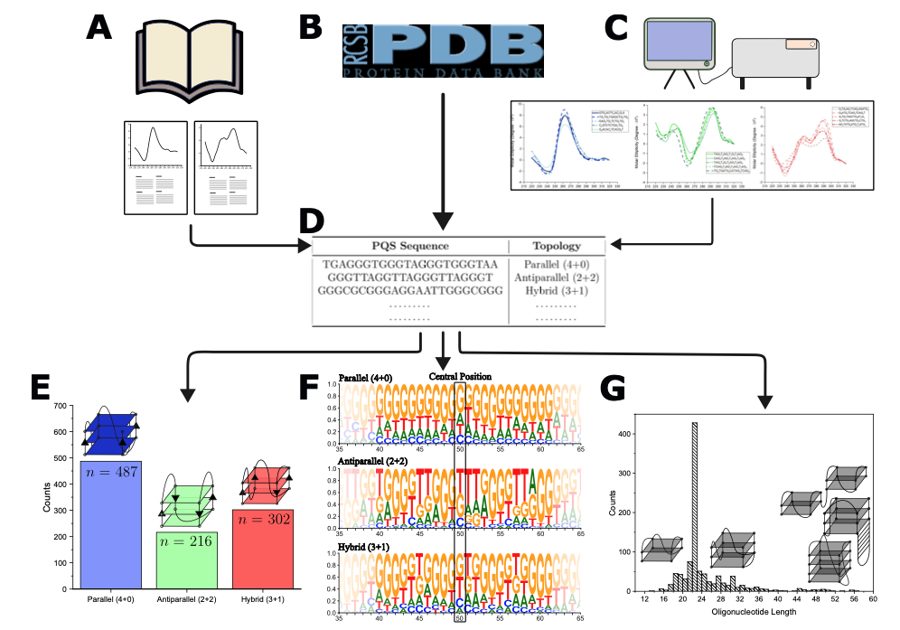
Figure from “Machine learning-based prediction of DNA G-quadruplex folding topology with G4ShapePredictor”

Machine learning-based prediction of DNA G-quadruplex folding topology with G4ShapePredictor

Donn Liew, Zi Way Lim, and Ee Hou Yong

Scientific Reports 14, 24238 (2024)

Abstract

Deoxyribonucleic acid (DNA) is able to form non-canonical four-stranded helical structures with diverse folding patterns known as G-quadruplexes (G4s). G4 topologies are classified based on their relative strand orientation following the 5’ to 3’ phosphate backbone polarity. Broadly, G4 topologies are either parallel (4+0), antiparallel (2+2), or hybrid (3+1). G4s play crucial roles in biological processes such as DNA repair, DNA replication, transcription and have thus emerged as biological targets in drug design. While computational models have been developed to predict G4 formation, there is currently no existing model capable of predicting G4 folding topology based on its nucleic acid sequence. Therefore, we introduce G4ShapePredictor (G4SP), an application featuring a collection of multi-classification machine learning models that is trained on a custom G4 dataset combining entries from existing literature and in-house circular dichroism experiments. G4ShapePredictor is designed to accurately predict G4 folding topologies in potassium (K+) buffer based on its primary sequence and is able to incorporate a threshold optimization strategy allowing users to maximise precision. Furthermore, We have identified three topological sequence motifs that suggest specific G4 folding topologies of (4+0), (2+2) or (3+1) when utilising the decision-making mechanisms of G4ShapePredictor.

AI for education

Generative AI can explain, check and coach, but it can also do students’ thinking for them. We study how to use it so that students become better, more independent learners of physics and mathematics.

AI and metacognition

How does generative AI change the way students plan, monitor and evaluate their own problem solving? Our projects look at physics education and at calculus problem solving, where AI acts as a learning partner rather than an answer machine.

A multimodal AI tutor for physics

With collaborators at Imperial College London, we are developing a personalised, multimodal AI tutoring system that gives physics students feedback, and curating the learning materials it draws on.

Student projects

  • Ang Yi Siang, URECA 2026–27. “Does AI help us learn? Exploring the effects of generative AI on metacognition in physics education”
  • Jain Aarjav, URECA 2026–27. “AI as a learning partner: investigating metacognition in calculus problem solving”
  • Vo Truong Thien Ky, URECA 2026–27. “Developing and curating physics learning materials for a multimodal AI intelligent tutoring system”
  • Wang Xinwei, MSc 2026. “Evaluating LLM-based agents for reliable and reproducible scientific analysis and reporting”
  • Chen Yipeng, MSc 2026. “AI-assisted agent-based modelling of collective foraging behaviour in ant colonies”

Teaching AI

  • AI for Sciences (PH6725), a graduate course for MSc students
  • Deep Learning with Python (PH6721), a graduate course
  • Instructor and invited speaker, 2026 NTU–Sorbonne University Joint Winter School on AI for Sciences. Talk: “Topology, Geometry, and AI: New Frontiers in Understanding Biological Systems”
  • Keynote, “Current Developments and Possibilities of Artificial Intelligence”, IPOS International, Singapore, 2023

See also AI in teaching and learning.